
Multi-channel monitoring
The system combines several optical signals to support a more robust interpretation than a single raw measurement.
Use your existing BIMS account. The classic login page remains available as fallback.
BIMS helps operators, engineers and biologists understand changes in water systems by combining four-channel optical measurements, physics-based interpretation, timeline events and AI-supported explanation.
View the flyer online or download it as a PDF.
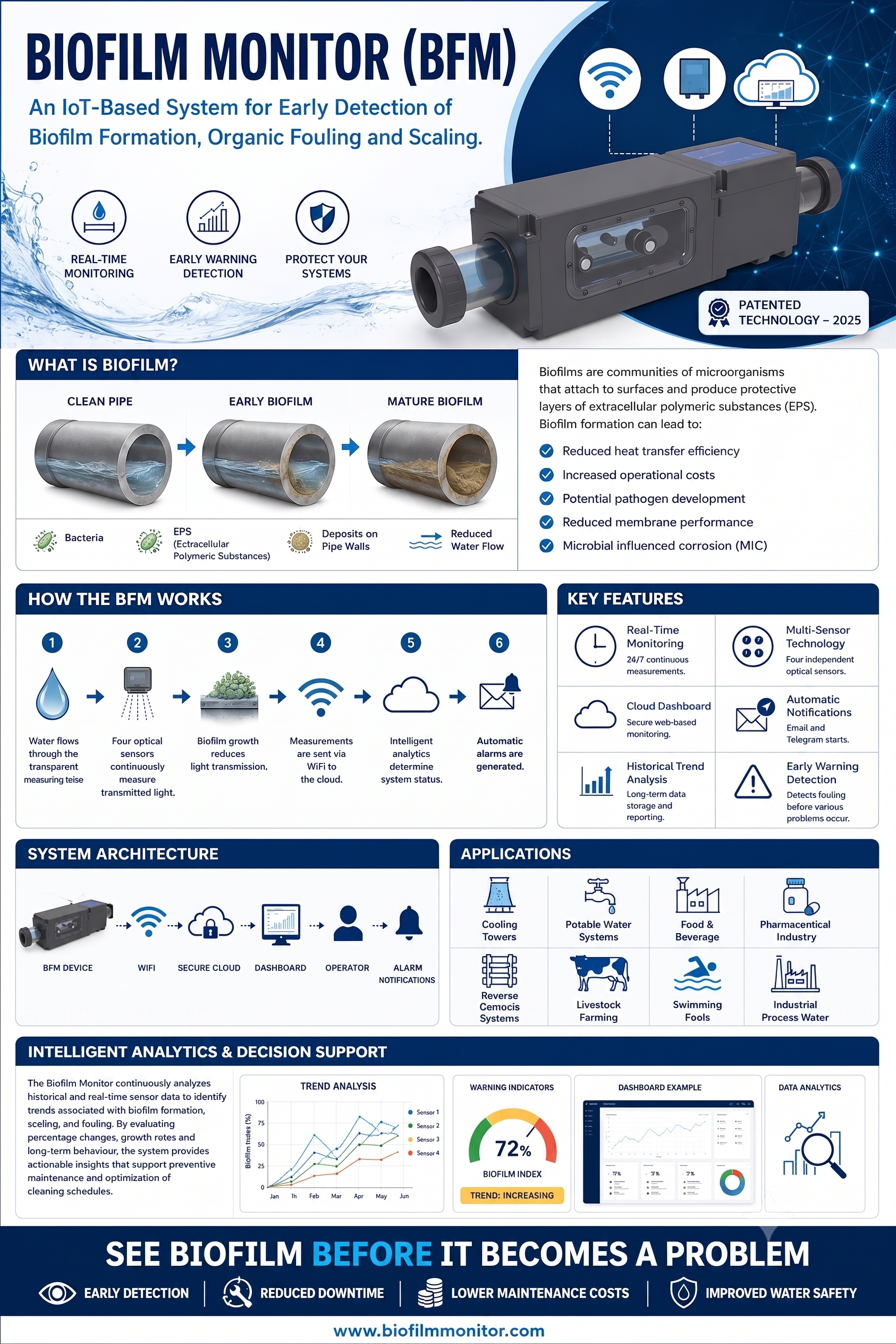
Download the flyer for a visual overview of the monitoring concept, system architecture, key features and typical applications.
 Patented Technology - 2025
 Real-Time Monitoring24/7 continuous measurementsMulti-Sensor TechnologyFour independent optical channels
 Cloud DashboardSecure web-based monitoring
 Automatic NotificationsEmail and Telegram alerts
 Historical Trend AnalysisLong-term reportingEarly Warning SupportWarnings before serious fouling problems
BIMS is designed to help users understand meaningful changes in water-system behaviour over time.
The system combines several optical signals to support a more robust interpretation than a single raw measurement.
BIMS focuses on persistent changes over time instead of isolated fluctuations, reducing the risk of noisy or accidental alerts.

Operators receive a clear status, timeline and recommendation, while detailed engineering data remains in the secure portal.
Four optical channels measure transmitted/reflected light through controlled geometries.
The analysis layer interprets measurement patterns and converts them into a practical system-health status.
Alarm status is based on validated model behaviour, trend and persistence — not a simple raw threshold.
AI helps explain the physics-engine result in human language. AI does not determine alarms.
| Traditional | BIMS |
|---|---|
| Raw lux threshold | Differential optical model |
| Single signal | Four optical channels |
| Reactive alarm | Trend + persistence |
| Limited interpretation | Physics result + AI explanation |
| Generic dashboard | PWA + timeline + notifications |
From municipal networks to industrial facilities, BIMS delivers early insight and continuous intelligence to protect water quality and system performance.
Prevent scale and fouling build-up for optimal efficiency.
Support clean, safe drinking water networks.
Protect product quality, process hygiene and water consistency.
Maintain ultra-pure water for critical processes.
Detect fouling early and extend membrane life.
Support reliable, hygienic drinking water for livestock operations.
Keep water crystal clear and swimmer-safe.
Prevent downtime and protect critical operations.
A BIMS demo is arranged directly with our team so we can focus on your application, monitoring goals and operating conditions rather than show a generic presentation.
Open the contact form and choose a subject such as “Demo request”.
Mention the application, water system, current monitoring challenge and what you would like to evaluate.
The BIMS team will follow up to arrange a suitable online or on-site demonstration.
During the demo we can walk through the parts of BIMS that are most relevant to your installation.
Already have a specific question? Include it in the request and we will prepare the demo around it.
Request a demo or log in to the existing production portal. Production APIs remain unchanged.